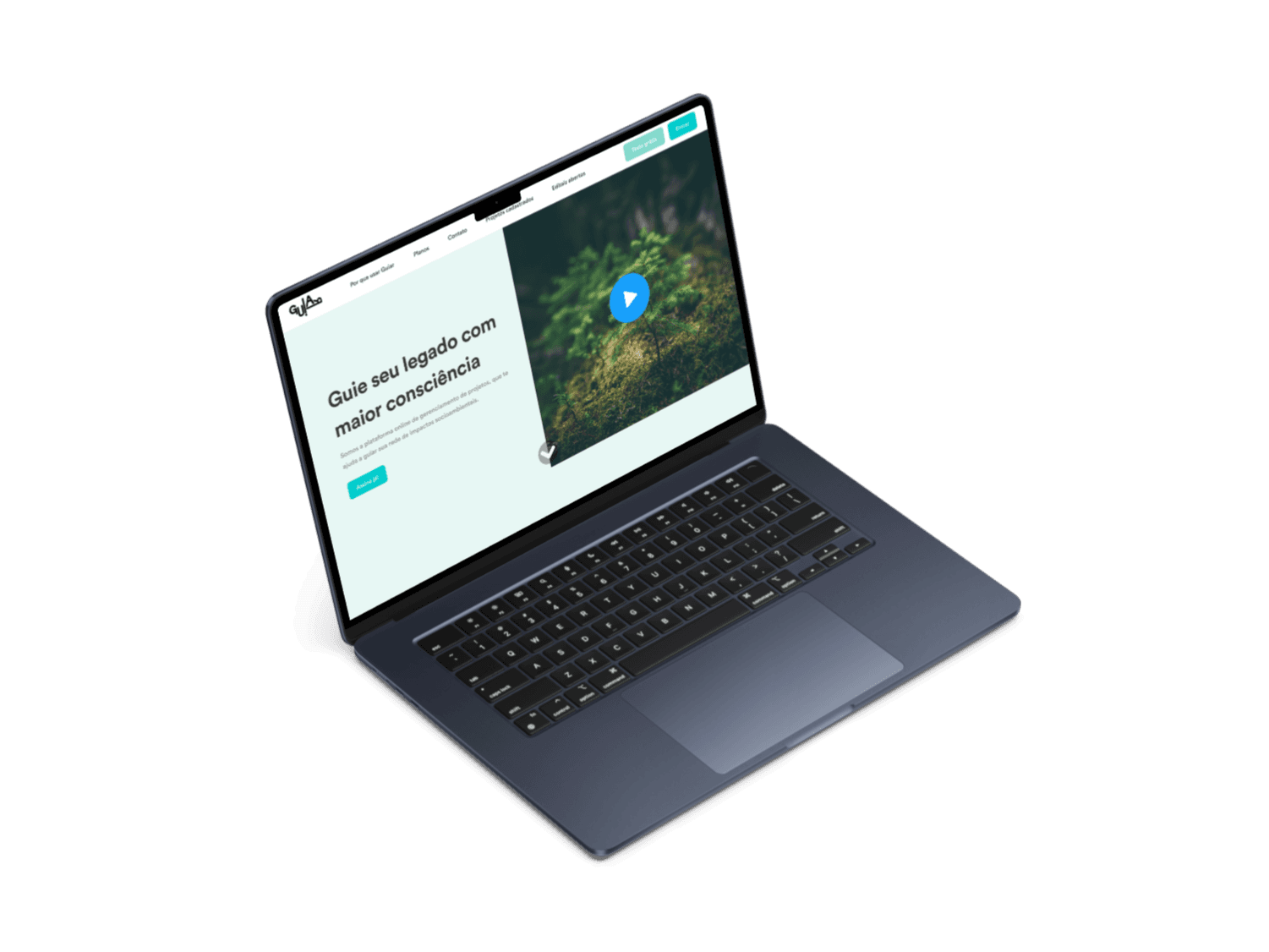
GUIAR · UX/UI Design
Replacing guesswork with measurable impact: launching GUIAR for entrepreneurs and social investment organizations
- UX/UI Design
- Service Design
- Data-Driven Product
- Startup Solution
Context
GUIAR is a web platform for organizing, measuring, and guiding investments in social and environmental projects, built for managers at institutes and fashion companies with socio-environmental responsibilities.
My role
UX/UI Designer & Researcher.
Objective
Give managers a way to organize, track, and guide their social investments with actual data behind each decision, instead of scattered, disconnected tracking.
Company & User
The problem
Managers responsible for socio-environmental investments struggled to align those investments with company strategy in a data-driven, efficient way. Without a structured system, tracking impact across multiple projects meant fragmented information and decisions made on incomplete pictures.
Two distinct users, one platform
- Entrepreneurs running social/environmental projects needed to manage project data, track investment, and measure their own impact
- Organizations (institutes, socially responsible companies) needed to monitor progress across multiple initiatives, generate reports, and confirm alignment with organizational goals
What success looked like
A platform where both sides could make data-driven decisions, not just log activity.
Process
Discovery and research
- Jobs to be Done framework, to understand the recurring tasks each user type actually needed to accomplish
- User journey mapping, to identify every touchpoint across the experience
- Functionality flow mapping, modeling how users would actually navigate between pages and features
- Benchmarking and needs validation, through a quantitative survey with entrepreneurs and organizations
- Atomic UX Research, compiling insights and recommendations tagged to specific screens in Miro, keeping research traceable back to design decisions instead of getting lost in a deck
Prototyping
Started with low-fidelity wireframes to quickly validate structure and navigation, then built an interactive Figma prototype integrating the validated features. Two distinct flows were prototyped and tested separately:
- Entrepreneur flow: personalized dashboards and metrics for managing project data and tracking impact
- Organization flow: tools for monitoring multiple initiatives, generating reports, and checking alignment with organizational goals
Testing
Documented systematically in Notion, with recorded sessions capturing real user feedback, driving specific, traceable adjustments rather than general impressions.
Hi-Fidelity Screens
Results & Impact
- Two fully prototyped, independently testable user flows, each addressing a different stakeholder's real job to be done
- A research process traceable end to end: from Jobs to be Done, through Atomic UX Research tagging, to specific design adjustments in Notion
- Live prototypes for both the Entrepreneur Flow and the Organization Flow
Closure & Relevance
The hard part of GUIAR wasn't either flow individually. It was designing a single coherent platform where "impact" means something comparable across two audiences with completely different vocabularies, incentives, and literacy with data, without flattening either one into a generic dashboard neither would actually use.
Why this matters for Product Design and Service Design roles
This case demonstrates structured, traceable research (Jobs to be Done through to Atomic UX Research), and the specific challenge of designing multi-stakeholder data products, where the same underlying information needs to serve very different decisions depending on who's looking at it.